🤖 Who is accountable when AI makes the wrong decision?
- Mohamed Essmat

- Aug 9
- 2 min read
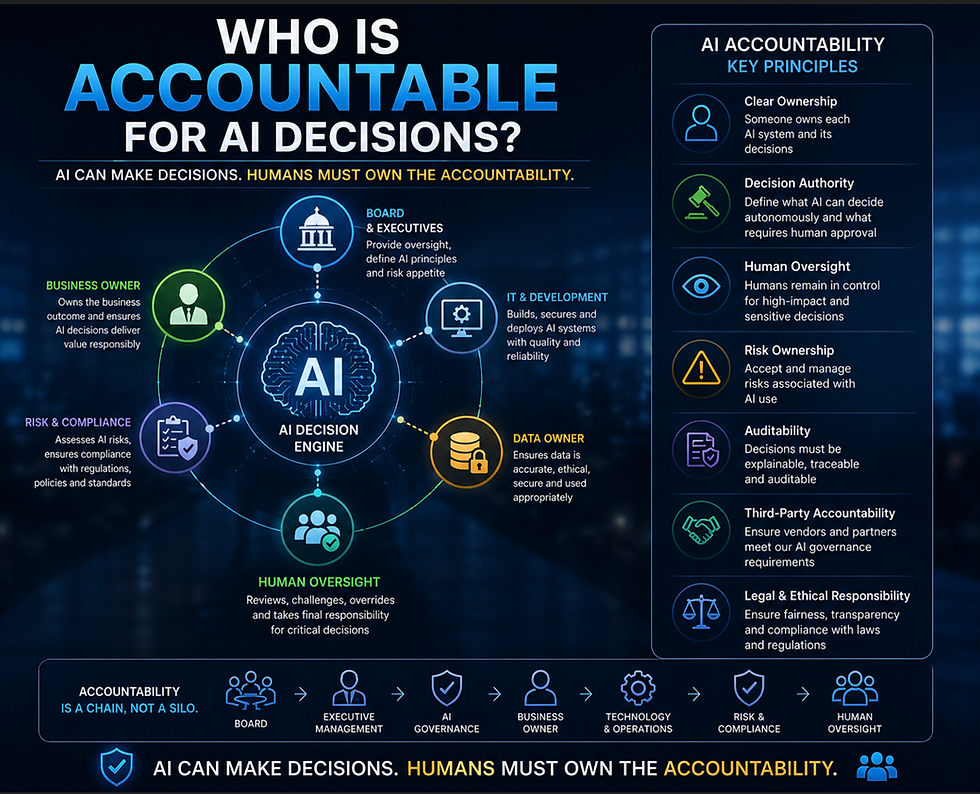
🤖 Who is accountable when AI makes the wrong decision?
The developer who built the model?
The IT team that deployed it?
The business unit using it?
The vendor providing it?
Or senior management who approved its use?
As AI becomes embedded in hiring, finance, cybersecurity, customer service, risk management, and operational decisions, one principle must remain clear:
AI can make decisions.
AI cannot take accountability.
Accountability must remain human and organizational.
Every organization deploying AI should clearly define:
✅ AI Ownership : Who owns each AI system and its business outcome?
✅ Decision Authority : Which decisions can AI make autonomously, and which require human approval?
✅ Human Oversight : Who reviews, challenges, or overrides AI decisions?
✅ Risk Ownership : Who accepts the risks associated with AI use?
✅ Data Accountability : Who ensures the data is accurate, appropriate, secure, and legally used?
✅ Auditability : Can we explain how an important AI assisted decision was reached?
✅ Third-Party Accountability : Who governs AI services provided by external vendors?
This is why AI governance frameworks such as ISO/IEC 42001, NIST AI RMF, and the EU AI Act are becoming increasingly important.
Organizations need more than an AI strategy.
They need a clear AI accountability model connecting:
Board → Executive Management → AI Governance → Business Owner → Technology → Risk & Compliance → Human Oversight
The goal is not to slow innovation.
The goal is to ensure that innovation happens with clear ownership, controlled risk, and responsible decision making.
Because when an AI decision causes financial loss, regulatory exposure, discrimination, security incidents, or reputational damage...
“The AI decided” is not an accountability model.
💬 If an AI system made a critical wrong decision in your organization tomorrow, would everyone know who is accountable?


Comments